
Looking back at this year, I can confidently say it reshaped me in ways I could never imagine. Hackathons, communities, mentoring, and constant learning all blended into a year that pushed me far beyond my comfort zone.
The Big Picture
A year ago, I never imagined I would become this version of myself. As I write these words, I genuinely feel like a different person. Different mindset, different priorities, and a much deeper way of thinking about growth, learning, and giving back.
Key Milestones
Hackathons
I participated in five hackathons and won three of them. Of course, the prize money is a nice incentive, and honestly it does motivate you to join from the start. But what really mattered was the chance to build something meaningful under pressure.
I have always been competitive by nature. If you have read Surrounded by Idiots, I clearly relate to the Red type, and I highly recommend reading that book. Hackathons amplify that competitive side. They either awaken it or sharpen it even more over time.
The hackathons I did not win were just as important. I am not being hypocritical when I say that. Every loss forced me to sit down and reflect. What did not work? Why was our solution not strong enough? What should I change next time? This does not mean I will definitely win the next one sadly XD. Improvement takes time, discipline, and consistency. I kept reminding myself to stay serious about learning and evolving after every experience.
Both winning and losing share the same core benefit. Hackathons give you something almost nothing else can. Real pressure. Real constraints. Real teamwork. Imagine starting after already being awake for four or six hours, then pushing through a full twenty-hour hack. Not everyone can endure that and stay focused until the very end.
Over time, I built a kind of immunity to sleep when needed. Working for twenty hours straight became manageable, and I could even push close to two days if necessary. Honestly, it felt amazing. Yes, you pay for it later with two days of dead deep sleep, but in my opinion, it is always worth it, even when you lose.
Becoming a Qdrant Star
Becoming a Qdrant Star opened doors I never thought I would walk through. It gave me the chance to learn every single day, talk with people I never imagined I could interact with, and engage with international communities.
I contributed in the simplest but most honest way I could. Articles, blogs, and tutorials. I focused on explaining things I personally struggled to find or only understood after wasting hours searching. My goal was to centralize knowledge so others would not repeat the same frustration. Same type of tutorials, same place, clear and accessible.
I actively asked for feedback, and I received way more than I expected. References, collaborations, short calls, and meaningful discussions, not only with Tunisians but with people from all over. That still gives me chills. It motivates me to do more and give back even more.
I have always felt that I owe the community a lot. Whatever I give back will never fully repay what I received. Regardless of that, I genuinely love what I am doing, and that makes everything feel natural.
Community Building with GDG SUP’COM
During the last summer near the ending of my end of studies internships, I thought why not start building the GDG SUP’COM GitHub organization. Same philosophy. Centralization. One place that contains workshops, materials, and shared content. Next year, I am considering building a small portfolio for the club to showcase useful resources and knowledge for everyone.
My Year in Code
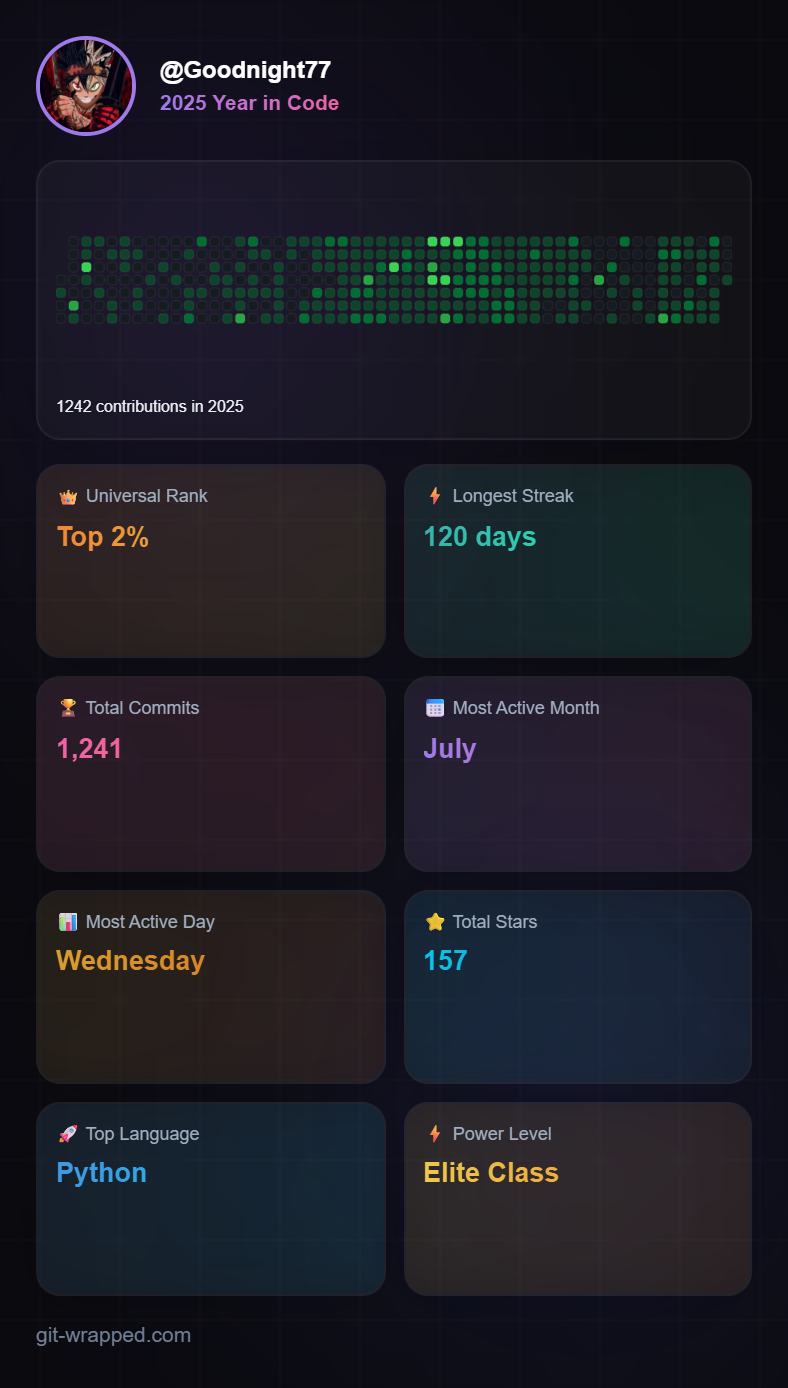
It was a great year, with most of my contributions being either in private organizations or personal repos. I’m not really a fan of showing off my GitHub heatmap, and I don’t think the number of commits is a way to show that you are skilled or smart.
July was a peak of commits, maybe because it was the start of new work with a lot of contributions and modifications. Meanwhile, I was contributing to organize the GDG community organization mentioned before and some other personal stuff. Also, I think July is when I built this portfolio that you are reading from (would really love to know what you think about it, do i need to change its colors?).
Mentorship and Growth
This year, I believe I successfully mentored two amazing GDG communities. I helped coordinate two events, one with a blockchain and green energy company and another with GDG Carthage. Watching people grow while you push them to become better versions of themselves is a powerful experience. At the same time, they slowly shape you into someone new as well.
I was a technical mentor in one of them and hosted my fourth Kaggle hackathon. Surprisingly, it felt just as exciting as the first time. I also mentored at a DevFest focused on Responsible AI. Seeing strong ideas emerge in just 15 hours was fascinating.
What I enjoyed most was being challenged. People questioning you, testing your understanding, and forcing you to respond clearly. Their feedback, combined with self reflection, felt very similar to reinforcement learning. Interact with the environment, fail, learn, adapt, and improve over time. No surprise, I am a big fan of RL.
The Judge’s Perspective
This year also gave me the chance to be a judge in several hackathons and events. This opportunity wasn’t as easy as I initially thought. Judging someone’s work requires fairness and objectivity for every team. My favorite part was the Q&A sessions digging into how teams thought about their problems and how they implemented their solutions.
Through three judging experiences, I reviewed countless gitHub repos and presentations. I can confidently say that we have an incredible amount of creative talent here. I was genuinely surprised by the level of innovation and novelty I saw. Most importantly, it allowed me to connect with many people through their work.
If you are one of the participants who didn’t win a hackathon I judged and you are reading this right now, I truly hope you can relate to what I shared in the “Hackathons” section above. I hope you learned something new, even if you didn’t take home a prize. I am always open to chat, so please reach out if you want feedback or just want to talk.
Additional Milestones
This year also come with several firsts that meant a lot to me, I delivered my first onsite workshop, thanks to IEEE CS INSAT. standing infront of people, sharing knowledge in real time, and feeling that direct exchange of energy was a completely different experience from writing or mentoring online.
I also got my first PR accepted. even though it was documenatation changes and small updates, the feeling was unreal. Seeing your name attached to a real contribution, no matter the size, makes you want to do more. Next year will aim to contribute to more advanced parts of the OSS.
After two previous attempts, i finally won my 1st INDABAX hackathon. That win meant more to me than most others because it came after persistence and failure. IMO it was a reminder that progress is not always linear, but consistency eventually pays off. I also started a Linkedin newsletter called The Neural Nexus, it is another way for me to share ideas or tutorials just like in medium but in different application.
Lessons Learned
-
Giving to the community always comes back. Maybe not today, maybe not tomorrow, but one day it will happen without you even noticing.
-
You do not have to agree with everything your supervisor or manager says. I used to challenge ideas openly, but this year I learned when to step back. Sometimes people need to see things fail before they understand. When they eventually come back to your original point, you realize patience is also a form of intelligence.
-
Choose your mentors wisely. I am not just talking about academic supervisors. The mentors I found this year played a huge role in my growth. Beyond my local circle, I learned so much by following Andrej Karpathy and Yann LeCun on X and YouTube.
-
I just believe in this quote from an article that i read months ago “Publish what you write. Even if it is published to an audience of no one, you will be able to point people back to it later.”
-
I believe that telling people you can do great work is easy; any idiot can do it, and many idiots do. The real challenge is proving it through action. Let your code and your projects speak for you.
My Personal POV on AI
It is fascinating to see how far AI has come. From AlphaFold’s breakthroughs to the rise of agents and LLMs, automation is reshaping every company and startup I know. I am especially excited to see what 2026 brings, particularly at the intersection of AI, medicine, and biology. I believe we will see these industries transform in ways we can’t yet fully imagine.
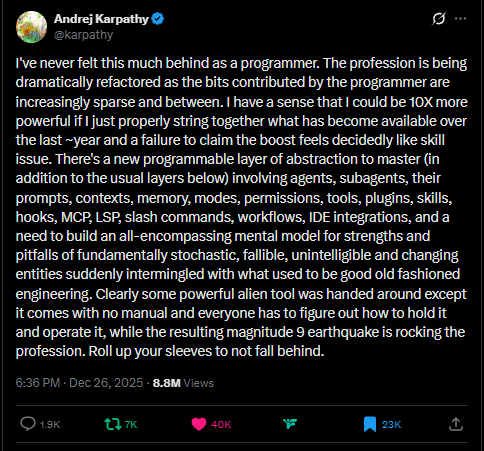
Just yesterday, Andrej Karpathy shared a sentiment that resonated deeply with me. He described the current state of programming as being handed a “powerful alien tool” with no manual, where the profession is being “dramatically refactored.” It feels like we are all trying to figure out how to operate this new layer of abstraction—agents, prompts, context while the ground shifts beneath us. It is a mix of excitement and the constant pressure to not fall behind, but as he said, we just have to roll up our sleeves.
Looking ahead, I am entering the next year with more curiosity than certainty. More focused on building, contributing, and learning deeply rather than chasing outcomes. If this year taught me anything, it is that growth compounds quietly when you show up consistently.
Finally, I am grateful to luck itself (which I truly don’t believe in XD), as I am grateful for the people who worked with me and helped me grow, and for those I met on various occasions.
(END)